Featured Article
Building Resilience in the Face of California Wildfires and Mudslides
By Linda Helland, MPH, CPH | February 2018
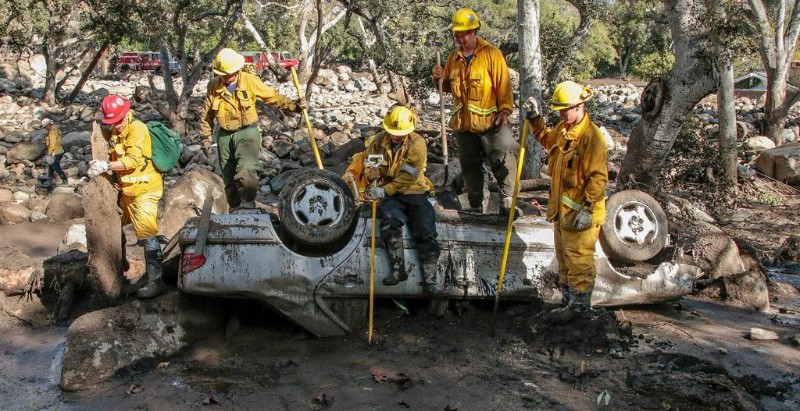
Photo: NBC Los Angeles, 2018.
In December 2017 – a time when firefighters used to be off for the season - California experienced its largest wildfire in state history, with 105,000 people evacuated and 283,000 acres burned in the southern part of the state. Then just a month later, almost an inch of rain fell in 15 minutes onto the charred and denuded earth in the Montecito area. According to
Jayme Laber, a hydrologist with the National Weather Service, that was four times the amount of rain needed to trigger mud and debris flows from the Thomas Fire burn area, and a once-in-every-200-years event. After being evacuated for many days due to the fire,
some Montecito residents may have had "disaster burnout" – a term now being applied to the wealthiest state in the union – and may not have realized the severity of the mudslide danger.
On January 8th in a matter of seconds the liquefied mountain with its load of boulders crashed down, taking 23 human lives and destroying 166 structures. We've heard heart-rending stories of victims dying in each other's arms.
"As with so many other families, we know that as their house came down around them -- our girls clung to each other as best they could while being washed away," wrote Taylor Owens of his sisters Sawyer Corey, who was 12, and Morgan Christine Corey, who was 25. The family's grief "is immense, insurmountable, and impossible to communicate," Owens stated.
It is hard to maintain composure when reading about the full lives that have been suddenly cut short and grieving family members. How many stories do we not even know of homeless people who were washed away by the river of mud, or people who were undocumented and afraid to evacuate to official shelters for fear of Immigration and Customs Enforcement?
We know from research done on past disasters such as hurricanes Sandy and Katrina, that about 3 out of 4 disaster survivors experience mental health impacts, with 65% of survivors experiencing post-traumatic stress disorder (PTSD) and 37% experiencing major depression.[1] Research is underway now to assess the mental health impact of the deadly October Wine County fires and the December Thomas fire.
After a year of unimaginable climate superlatives – wettest, hottest, deadliest, biggest – the climate-related disasters are likely going to get worse in the years ahead, not better, due to increasing climate change.
Many people - not only in California but around the United States and the world – are feeling weary of not only the ever-increasing disasters, but also of the insufficient action to reduce the greenhouse gas emissions that fuel the problem. Many people are feeling hopeless about the future. However, the state of California is providing international leadership through innovative and aggressive climate action. Providing hope is one reason why the Climate Change and Health Equity Program is holding the next Public Health Workgroup of the California Climate Action Team on the capacity for carbon farming practices to harness the age-old process of plant photosynthesis to take carbon from the air and put it back into plants and soil, where it has beneficial effects on crops, the environment, and human health. Building soil carbon through agricultural and rangeland practices has the potential to increase crops' yields and resilience to pests and severe weather, and reduce the need for pesticides and fertilizers. It can also help crops retain water, thus reducing the need for irrigation and possibly reducing flooding. The carbon that is removed from the air and stored long-term in soils reduces greenhouse gas levels, and if done on a large enough scale, could reduce climatic changes and their devastating effects on people's health and well-being in California and around the globe. Click here to register for the February 7th Public Health Workgroup webinar, and
click here to sign up to be notified of these meetings in the future.
We also know from past research that after disasters only 22-27% of survivors experience dysfunction or mental health consequences over the long term; the rest are resilient.[1] At the
Office of Health Equity, we support research, programs, policies, and practices that increase resilience for all people, especially those who suffer the greatest historical and continuing inequities, by improving living conditions with and for communities experiencing inequities -- before, during, and despite climate-related events. For example, the
California Reducing Disparities Project seeks to explore the mental health impacts of climate change and associated extreme events by identifying tools, resources, interventions, and best practices. This information will be shared with grantees of the Project, whose aims are to evaluate the effectiveness of community-defined evidence practices to reduce mental health disparities in African American, Asian and Pacific Islander, Latino, LGBTQ, and Native American communities.[2]
Linda Helland is the Team Lead for the Climate Change and Health Equity Program of the Office of Health Equity.
[1] Sergio Aguilar-Gaxiola, presentation at International Transformational Resilience Coalition's conference, January 25 2018, citing Fran Norris at Dartmouth Medical School and National Center for Disaster Mental Health Research
[2] California Natural Resources Agency. Safeguarding California Plan: 2018 Update. 2018:97