As public health agencies, we hold responsibility for protecting and promoting the health of all people in California. Climate change, the greatest health threat of the 21st century, fundamentally imperils human health¹ across all sectors of society. While no local health jurisdiction (LHJ) acting alone can prevent the global health impacts of climate change, local public health action is essential to reducing climate-related morbidity and mortality in our communities.
At the statewide level, the California Department of Public Health's (CDPH) Climate Change and Health Equity (CCHE) Branch addresses this threat by
At the local level, climate work in public health serves two primary functions:
- implementing preventive efforts to address the current and coming health and equity impacts of climate-related hazards and diseases (climate change adaptation), and
- collaborating across agencies to strengthen and accelerate local efforts to reduce fossil fuel emissions and future climate changes (climate change mitigation), which will lessen the frequency and severity of climate hazards our communities face in the decades to come.
Climate Change Adaptation
Now, not only are increased and more severe climate-related disasters like extreme heat, wildfires, and flooding events a fact of life, but other climate-related hazards, including changes in vector ecology and increased air pollution, pose direct threats to the health of current and future generations of Californians.
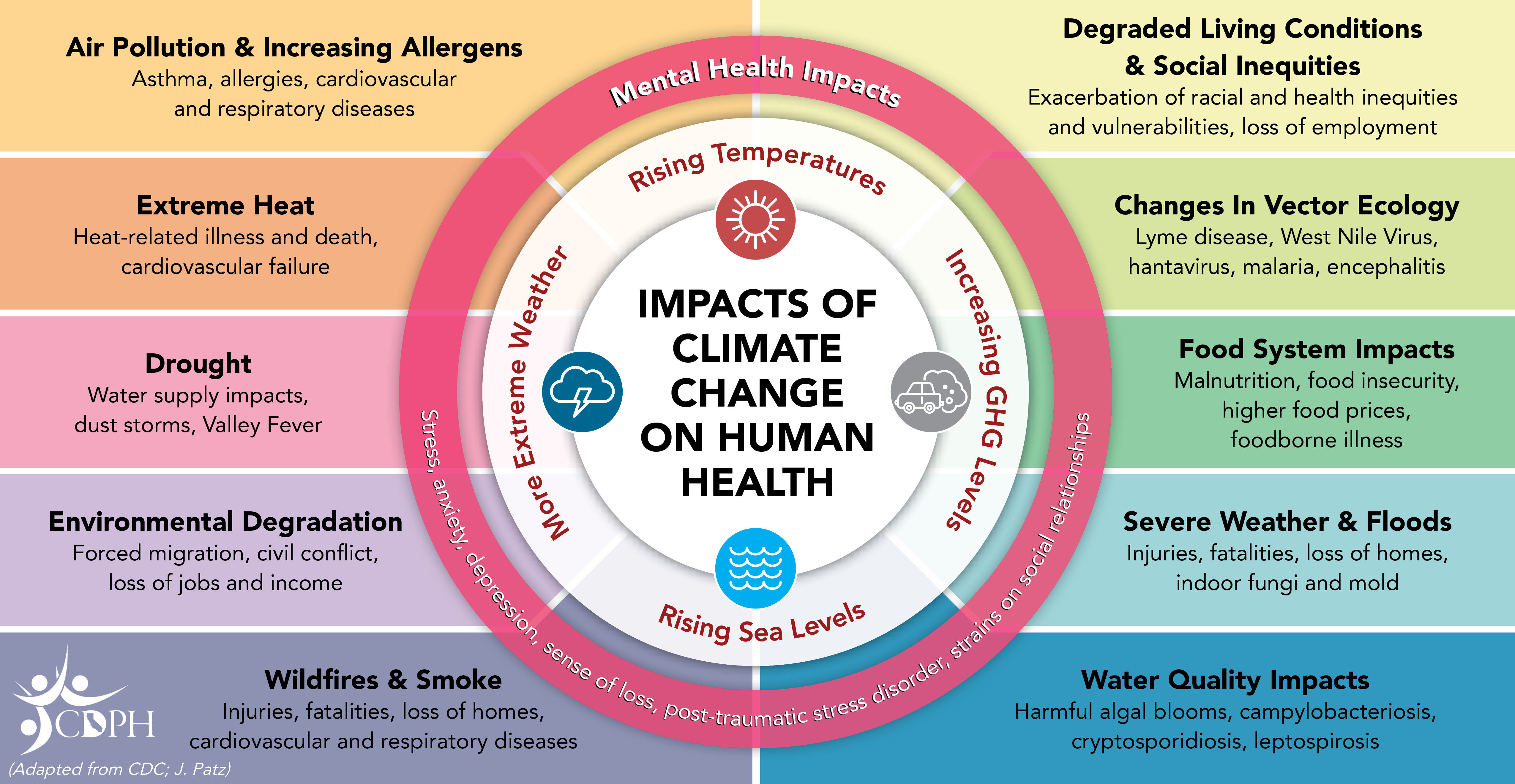
Climate change is altering the health landscape, with shifting environmental conditions creating new pathways for and patterns of communicable diseases and chronic conditions. While essential programs must continue, LHJs must also have eyes on the future, building agency knowledge of and capacity for responding to emerging climate-related threats to health.
There's an ever-increasing trove of data and research telling us what to expect and how we can effectively address these emerging threats. LHJ staff with time and capacity to find and integrate this knowledge into local practice are now essential to promoting resilience in local populations, particularly in the expected absence of federal leadership and changing pathways for data access.
Climate Change Mitigation
Public health departments protect communities by focusing on upstream interventions for addressing existing, emerging, and worsening threats. Climate change is a threat multiplier that impacts everything we care about in public health, from disease and disasters to community living conditions. Talking about health impacts and the health benefits of taking action helps motivate people to support climate change mitigation policies such as reducing fossil fuel use; in fact, protecting health is a top reason Americans select for supporting climate solutions.²
Reducing fossil fuel extraction and use helps slow climate change and provides immediate health benefits such as improving air quality, while preventing the worst projected climate impacts in the future. However, no single jurisdiction can eliminate the broader health impacts of climate change on its own. Like public health responses to infectious diseases or tobacco use, addressing climate change requires coordinated action at all levels of society.
Opportunities
- Funding: Because climate change requires an all-of-government response, it creates unique partnership opportunities across local agencies, CBOs, utilities and private partners, which can open new funding streams to public health participation.
- Capacity building: Directly addressing climate change at the local public health level can strengthen relationships with other local agencies (e.g., local planning, public works, emergency management, and other departments) and increase overall local capacity for policy, systems and environmental (PSE) approaches to public health issues.
- Workforce: Results from the evaluation of CDPH's LHJ Climate and Health Community of Practice indicate that the number of LHJ staff with strong interest in addressing climate change far exceeds the number of available positions, highlighting a workforce development opportunity.
In the context of limited resources, we must consider not only what is needed, but where we can have the greatest impact. LHJs are uniquely positioned to advance climate action by communicating the health impacts of climate change and the health benefits associated with taking climate action, and helping to frame policy solutions that drive resilience. LHJs operate at the intersection of government and the communities most vulnerable to climate threats, with a mandate to direct resources where they are needed most. Leveraging this role, while expanding partnerships across local agencies, offers a vital opportunity to strengthen community resilience and elevate public health's influence in shaping climate solutions.
How to Operationalize Climate and Health Work
The NACCHO Climate and Health Program Guide (PDF 10.3MB) presents four models for how LHJs can organize their climate and health work along a continuum of increasing scope for LHJs establishing a new climate and health program or building capacity for an existing one. The models range from lower-resource Champion or Committee structures to higher-resource Coordinator staff positions or Full Program establishment.
Larger health departments will benefit from using a Coordinator or Full Program model to bridge diverse public health programs and add essential capacity for coordinating with other local agencies. Full Programs can ensure internal capacity to address local climate stressors.
Integrating climate change into public health planning and programs fits naturally with the Public Health Accreditation Board standards and measures. For instance, staff with understanding of climate change's effects on the ranges vector-borne illnesses and effective protective actions improves an LHJ's ability to “anticipate, prevent, and mitigate health threats through surveillance and investigation of health problems and environmental hazards." (Standard 2.1). In addition, local public health cross-agency involvement in climate resilience efforts can both ensure an LHJ's ability to “maintain awareness of public health issues that are being discussed by those who set policies and practices that impact public health" (Measure 5.1.1A) and offer an opportunity to “address factors that contribute to specific populations' higher health risks and poorer health outcomes" (Measure 5. 2.4A).
Many local health jurisdictions in California (and across the country) are planning and implementing projects to protect public health in the face of climate change.