Feature Article
A Life and Death in Service to Humanity and the Planet
By Linda Helland, MPH, CPH | May 2018
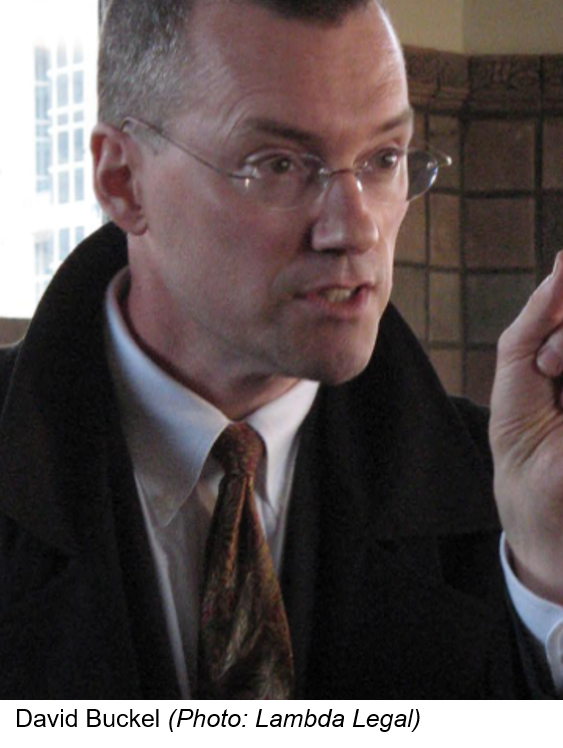 | In the protest tradition of Thích Quảng Đức, the Buddhist monk who self-immolated in 1963 to protest the persecution of Buddhists by the South Vietnamese Diem government, 60 year-old David S. Buckel poured fossil fuels on his body and lit himself on fire in the early morning of April 14, 2018.
A civil rights attorney, Mr. Buckel was known as a proponent of rights for LGBTQ people. Hailed as a "brilliant legal visionary" by Lambda Legal, where he had been Marriage Project Director, he led a successful case in the New Jersey Supreme Court that recognized the tangible harms to same-sex couples and their children from being denied the rights of marriage, and filed a marriage lawsuit in state court in Iowa in 2005, at a time when only Massachusetts permitted same-sex couples to marry. When the Iowa Supreme Court delivered the plaintiffs a unanimous victory in 2009, Iowa was only the third state in the country where same-sex couples could marry.[1] |
A 1996 case in Wisconsin brought by Mr. Buckel resulted in a landmark victory for a gay high school student forced to drop out of school as a result of inaction by his school administrators in the face of brutality perpetrated by other students, and marked "the first time a federal court had ever held that schools have an obligation to prevent anti-gay bullying," according to Lambda Legal general counsel Hayley Gorenberg.[2]
Mr. Buckel was best known for his work to secure justice for Brandon Teena. Teena was a transgender man who was brutally raped by two men in Richardson County, Nebraska, in 1993, at the age of 21. Teena reported the crime to Richardson County Sheriff Charles Laux, who not only treated Teena with disrespect and failed to protect him, but also notified the perpetrators of the rape accusation. Within the week the perpetrators found Teena and murdered him. In 2001 David Buckel argued the lawsuit brought by Teena’s mother before the Nebraska Supreme Court, which found that "[Sheriff] Laux’s conduct was extreme and outrageous, beyond all possible bounds of decency, and is to be regarded as atrocious and utterly intolerable in a civilized community."[3]
According to Lambda Legal, the case was "one of the most important in LGBT history for helping to bring visibility to the transgender community" and it "strengthened the principle that law enforcement officials must be held accountable for fair treatment of people who are the targets of hate crimes." Gorenberg reflected, "Taking a high-profile case like this up to the Nebraska Supreme Court to say that a transgender person’s life is not cheap, and fully deserves protection—that was pivotal."[4]
Before heading to Prospect Park his last morning, Mr. Buckel emailed the New York Times and other media outlets about the reasons for his self-immolation. "Most humans on the planet now breathe air made unhealthy by fossil fuels, and many die early deaths as a result. My early death by fossil fuel reflects what we are doing to ourselves."[5]
David Buckel’s life was about reducing injustices that result in needless suffering; in this sense he was a practitioner of health equity. His life and his death were solemnly devoted to reducing climate change and other environmental destruction, which he saw clearly are harming and killing human beings in an inequitable manner.
In his last 10 years, Mr. Buckel had served as a consultant developing community composting sites in New York City. His largest project was at the Red Hook Community Farm in Brooklyn, which in 2012 composted 225 tons of organics, entirely by hand. He wrote "Guidelines for Urban Community Composting" for the Institute for Local Self-Reliance.[6] He had come to understand, as have we in the Climate Change and Health Equity Program, that the regenerative power of soil, aided by compost, gives great hope as a proven method to return carbon from the air to the soil and plants, reducing greenhouse gases while growing healthy, resilient produce that nourishes people.
"He was very much someone who felt like he always wanted to make sure that while he was alive that he was doing more to make the world a better place," said Terry Kaelber, his partner of 34 years, "And he wanted to give more than he was taking from it."[7]
Mr. Buckel lived his convictions. He took showers with very little water, and walked one hour to work and back from his home at the edge of Prospect Park, rather than use fossil fuels for transportation. He even refused to use fossil-fueled tools at the composting site; evidence of a passion that friends say was his true fuel, according to the New York Times.[8]
Mr. Buckel’s communication to the New York Times discussed the difficulty of improving the world even for those who make vigorous efforts to do so. "Many who drive their own lives to help others often realize that they do not change what causes the need for their help".[9]
This was a recognition of the policies, systems, and societal structures that drive both the greenhouse gases that cause climate change, and health inequities, and of the fact that these systems’ effects are largely beyond the control of individuals. Individuals do not choose whether or not there are options to walk, cycle, or take transit to get to a destination, nor do individuals have control over how much ozone or particulate matter is in the air in their neighborhoods. It is the work of programs like ours, other governmental, non-governmental, private entities, and community-based social movements, to change the policies and systems that give rise to climate change and health inequities.
"This is not new," Buckel wrote of his final act, "as many have chose to give a life based on the view that no other action can most meaningfully address the harm they see…Here is a hope that giving a life might bring some attention to the need for expanded actions, and help others give a voice to our home, and Earth is heard."[10]
May we work together to heed David Buckel’s call for expanded actions, to honor his life and death, and to bring healing to the earth, its climate, and the people suffering now from its destruction.
Linda Helland is the Team Lead for the Climate Change and Health Equity Program of the Office of Health Equity.
[1] Lambda Legal. Lambda Legal Mourns the Tragic Death of Former Marriage Project Director David Buckel. https://www.lambdalegal.org/blog/20180414_tragic-death-former-marriage-project-director-david-buckel
[2] Allen S. When Brandon Teena Was Killed, LGBT Advocate David S. Buckel Wouldn't Let the Case Die. The Daily Beast. April 17, 2018. https://www.thedailybeast.com/when-brandon-teena-was-killed-lgbt-advocate-david-s-buckel-wouldnt-let-the-case-die
[3] Ibid.
[4] Ibid.
[5] Mays J. Prominent Lawyer in Fight for Gay Rights Dies After Setting Himself on Fire in Prospect Park. The New York Times. April 14, 2018. https://www.nytimes.com/2018/04/14/nyregion/david-buckel-dead-fire.html
[6] Buckel D. Guidelines for Urban Community Composting. BioCycle Magazine. https://ilsr.org/wp-content/uploads/2017/05/Guidelines-for-Urban-Community-Composting.pdf
[7] Robbins L and Ransom J. He Called Out Sick, Then Apologized for Leaving this World. New York Times. April 15, 2018. https://www.nytimes.com/2018/04/15/nyregion/david-buckel-brooklyn.html
[8] Ibid.
[9] Mays J. Prominent Lawyer in Fight for Gay Rights Dies After Setting Himself on Fire in Prospect Park. The New York Times. April 14, 2018. https://www.nytimes.com/2018/04/14/nyregion/david-buckel-dead-fire.html
[10] Wootson Jr. C. He fought for same-sex marriage for years — and set himself on fire to protest global pollution. The Washington Post. https://www.washingtonpost.com/news/post-nation/wp/2018/04/15/he-fought-for-same-sex-marriage-for-years-and-set-himself-on-fire-to-protest-global-pollution/?noredirect=on&utm_term=.74986ec430ab