
FLOURISH Initiative FLOURISH Local Health Jurisdiction Key Informant Interview Findings
The
FLOURISH Initiative seeks to help youth, pregnant people and families foster a lifetime of mental wellness and resilience. F LOURISH uses training, technical assistance and data support to provide proactive, health-promoting strategies at the state and local level to support Maternal, Child and Adolescent Health (MCAH) programs. In 2023–2024, FLOURISH engaged Local Health Jurisdictions (LHJs) through key informant interviews to better understand the mental health landscape within these areas. This effort aimed to identify ongoing support needs and shape the most effective training, technical assistance and data resources for LHJs.
All 61 LHJs were invited to participate in the key informant interviews. Invitations were sent to MCAH Directors, Coordinators, County Health Executive Association of CA (CHEAC) and Local Public Health Officers. A survey was sent out to those who were unable to participate.
FLOURISH collected responses from 79% of all LHJs in California. 36 virtual interviews and 13 surveys were completed.
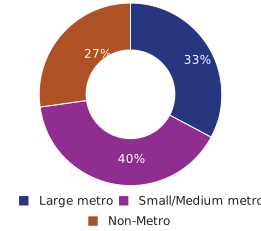
CDPH/MCAH used the 2013 CDC National Center for Health Statistics' Urban-Rural Classification Scheme for counties to understand the distribution of urbanicity across LHJs participating in the FLOURISH key informant interviews. Below are the percentages that participated by county urbanicity:
-
33% Large metro (urban): Counties with a metropolitan area with at least one million residents.
-
40% Small/Medium metro (urban): Counties with a metropolitan area with fewer than one million residents.
-
27% Non-metro (urban): Counties with a micropolitan area of fewer than 50,000 residents.
Data collection
- Conducted virtual interviews with two facilitators and one notetaker from the FLOURISH team.
- Surveys included open-ended responses reported by LHJ staff.
Data coding
- Identified key themes and subthemes across survey responses and interview notes.
- Finalized key themes and subthemes during team consensus meetings, resulting in a codebook to guide analyses.
Data analysis
- Combined survey and interview responses after comparing for meaningful differences.
- Summarized frequency of key themes and respective subthemes reported for each topic.
LHJ Key Informant Interview and Survey Questions
- Mental health concerns
- Assets for promoting mental wellness
- Barriers to addressing mental health needs
- Support needed to meet mental health needs
Key Findings
Mental Health Concerns
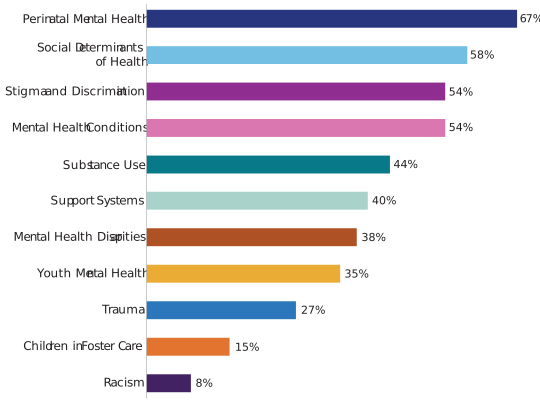
Key Takeaways - Providers lack training to treat perinatal mood and anxiety disorders as well as a knowledge of toxic stress, trauma, and infant and early childhood mental health. Inequitable access to mental health care due to a shortage of providers, lengthy assessments, inconvenient service times and travel barriers were also a major concern. Social Determinants of Health (SDOH), such as housing, transportation, and income status as well as stigma, often related to racial or cultural identity, worsen access to care and mental health outcomes. Additionally, substance use, often exacerbated by isolation and lack of support, can lead to heightened mental health risks.
The bars represent the percentage of LHJs that mentioned a concern in the respective categories. Some LHJs mentioned more than one concern.
Assets For Promoting Mental Wellness
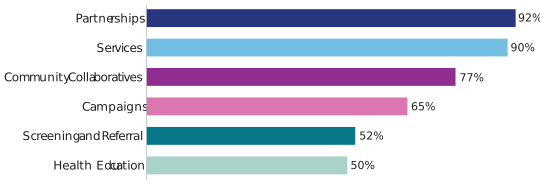
Key Takeaways - Counties are leveraging community partnerships to enhance program effectiveness and provide early support services, such as home visiting, that fosters healthy development and well-being from the earliest stages of life. Partnerships mentioned include First 5, Family Resource Centers, County Behavioral Health, Social Services, Promotores and many more. Successful partnerships occur when individuals strive to be innovative and make progress despite potential constraints.
The bars represent the percentage of LHJs that mentioned an asset in the respective categories. Some LHJs mentioned more than one asset.

Barriers to Addressing Mental Health Needs
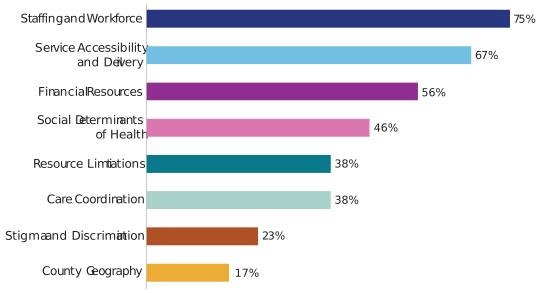
Key Takeaways - Staff and provider shortages, limited accessible services and insufficient funding create significant barriers to timely mental health care. Most intervention programs screen for mental health, however referral pathways are limited, and care coordination is lacking. Language differences, limited availability of specialty care, limited flexibility in how services are delivered, and long wait times prevent many individuals from accessing and receiving care. SDOH, such as lack of health insurance, homelessness, poverty and lack of transportation, leaves many families struggling to prioritize their mental health and wellness. These barriers highlight a need for a more balanced funding approach that supports both prevention and intervention services to effectively address mental health challenges in a comprehensive way.
The bars represent the percentage of LHJs that mentioned a barrier in the respective categories. Some LHJs mentioned more than one barrier.

Support Needed to Meet Mental Health Needs
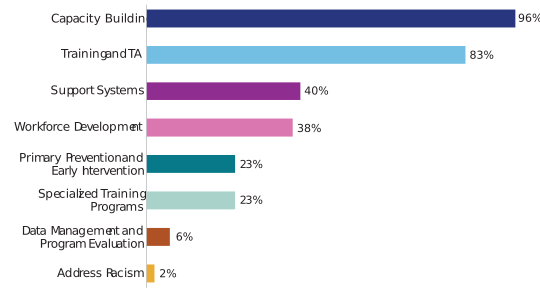
Key Takeaways - Programs are overwhelmed, and staff require ongoing training and technical assistance to ensure the workforce has the necessary skills to adapt to evolving needs and integrate new approaches into their programs. Staff also need support building capacity to enhance their existing infrastructure and help their organization grow stronger by building up skills, abilities and resources. Through comprehensive training and ongoing support, LHJs can empower staff to drive positive mental health outcomes and significantly enhance the overall impact of their programs.
The bars represent the percent of LHJs that mentioned a need in the respective categories. Some LHJs mentioned more than one need.

From Insights to Action
The FLOURISH Initiative, guided by insights from local key informant interviews, has established a strategic framework with
four focus areas to advance mental health efforts for the MCAH population.
These four focus areas are designed to promote mental well-being through targeted, sustainable actions. Below are the strategies the FLOURISH Initiative will implement to support MCAH program efforts to improve mental wellness:
Policy & Systems Integration:
- Integrate Policy, Systems and Environmental (PSE) change strategies into MCAH mental health efforts. FLOURISH will identify and incorporate these strategies into the existing framework and develop an implementation plan to ensure their sustainable integration.
Health Equity and Social Supports:
- Enhance coordination of mental health primary prevention strategies by partnering with internal and external stakeholders. Together, these partnerships will develop a shared action plan to integrate life course mental health strategies, aligned with the Title V action plan.
- Act as a connector and information broker for LHJs. FLOURISH will support LHJs in building partnerships with key organizations to advance mental health efforts.
Training & Capacity Building:
- Provide comprehensive training and technical assistance to state and LHJ staff. FLOURISH will deliver tailored training sessions, technical assistance, data support and resources to meet specific needs. FLOURISH will also host learning cohorts and evaluate their effectiveness through post-training surveys.
- Create opportunities for LHJs to collaborate and exchange best practices, lessons learned and innovative strategies for preventive mental health efforts. FLOURISH will establish structured forums for LHJs to share successes, address challenges and brainstorm solutions. FLOURISH will leverage mentorship models by pairing experienced LHJs with less experienced teams to guide the implementation of effective mental health strategies. Additionally, FLOURISH will promote cross-jurisdiction partnerships, encouraging joint projects that pool resources and ideas while fostering peer-to-peer learning. To inspire further innovation, the initiative will recognize and publicize standout LHJ projects and innovative approaches, motivating others to adopt or adapt these strategies.
Primary Prevention and Early Intervention:
- Conduct a comprehensive Mental Health Landscape Assessment every five years to evaluate the mental health needs and available resources within state and local MCAH programs. This assessment aims to uncover the key gaps and identify opportunities for enhancing mental health support for state and local MCAH programs. By actively engaging with stakeholders and analyzing current data, the assessment highlights areas in need of improvement and helps guide strategic planning to address those needs effectively. This process ensures that the FLOURISH Initiative remains responsive to the evolving mental health challenges faced in California.
- Build awareness of the FLOURISH Initiative efforts through a targeted communications plan. This plan will engage key audiences by producing and sharing educational resources with stakeholders, including LHJs and Community-Based Organizations.
- Collaborate with internal and external partners to integrate primary prevention mental health strategies into MCAH Division programs. The plan will identify best practices and lessons learned to enhance mental health outcomes for the MCAH workforce and programs at state and local levels.
