A 2°C world (half of what we’re hurtling toward) would bring significantly more drought, wildfires, floods, malnutrition and related growth stunting, child deaths, conflict, refugees, infectious diseases, mosquito-borne diseases such malaria, West Nile Virus, Zika, and Dengue, ozone-related deaths, and risks to worker safety and productivity than if we can limit warming to 1.5°C. United Nations Meteorological Agency Secretary General Petteri Taalas cautioned that “There would be 420 million less people suffering because of climate change if we would be able to limit the warming to 1.5°C [as contrasted with 2°C]”.
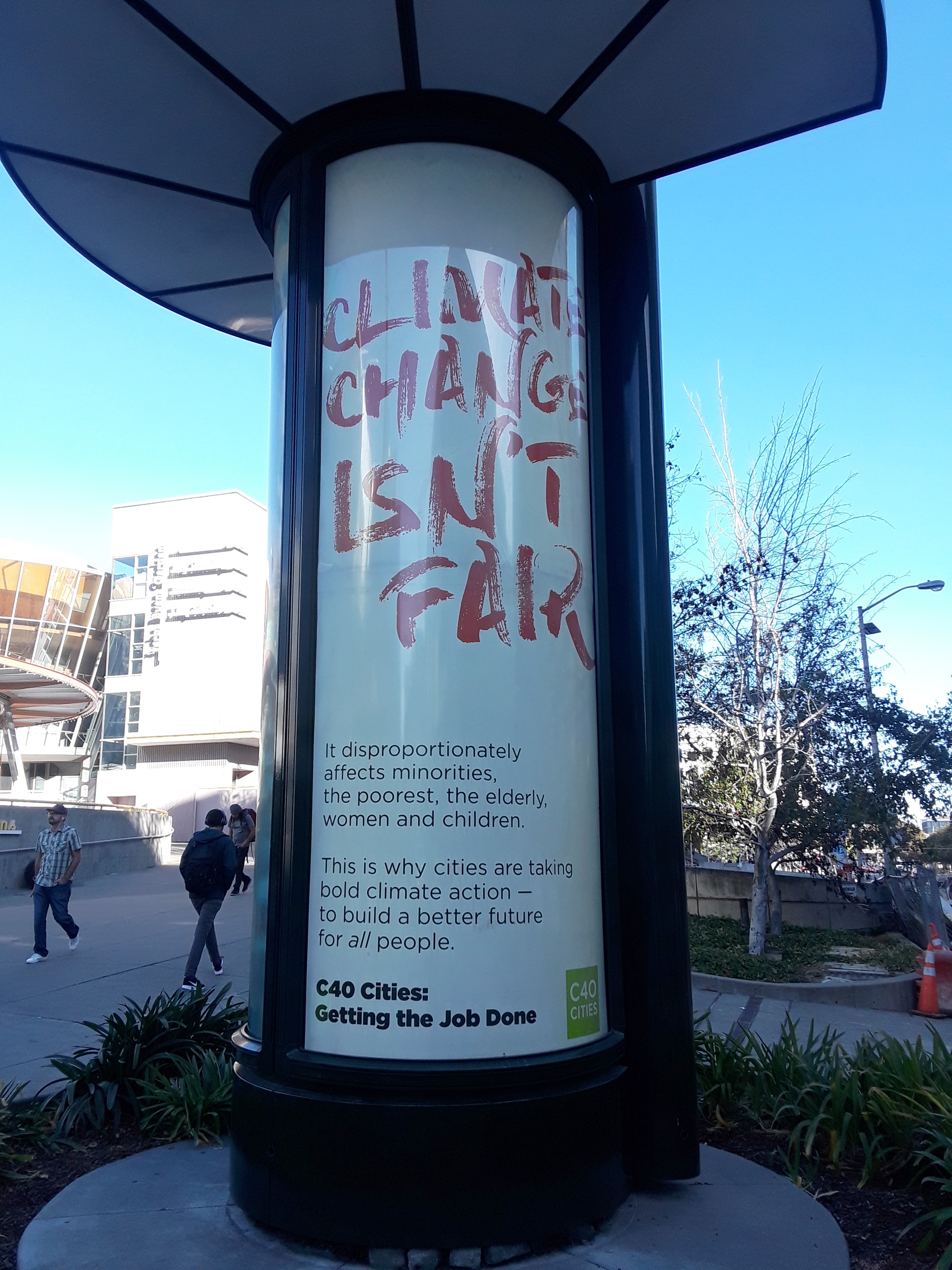
Street display ahead of the Global Climate Action Summit.
Climate change is a quintessential equity issue. Health risks from climate change are unevenly distributed and are generally greater for disadvantaged people and communities, according to the IPCC report. Over 96% of disaster-related deaths in recent years have taken place in poorer developing countries.[4] Climate change could force more than 100 million people into extreme poverty. Unmitigated warming could reduce average global incomes and widen global income inequality, said the IPCC. Income inequality has been linked to health and social problems[5] and heightened vulnerability to the harms of climate change.[6] And, research has shown that conditions of economic inequality make it far less likely that societies will act to reduce emissions sufficient to limit warming to 1.5°C.[7]
Debarati Guha, a contributor to a
United Nations report on Economic Losses, Poverty & Disasters from 1998 to 2017, said “Poor people in poor countries do not have 20 years, 30 years, 40 years. Most of those children will be dead... Either they will be dead because of the catastrophe itself, or they’ll be dead because of the prevailing persistent effect of malnutrition that comes along with these catastrophes”.
Inequity characterizes not only the suffering from climate impacts, but also the responsibility for climate change. Greenhouse gas emissions levels relate closely to the wealth of the emitters,
according to Kevin Anderson, with the wealthiest people in the world emitting thousands of times more greenhouse gases than the poorest. Almost half of global carbon emissions arise from the activities of just 10% of the global population, and about 70% of emissions come from just 20% of people. His suggestion: “Impose a limit on the per-capita carbon footprint of the top 10% of global emitters, equivalent to that of an average European citizen, and global emissions could be reduced by one third in a matter of a year or two.”
In addition to health and equity benefits, “This transformation to a zero carbon energy system will come with lots of long term secure job opportunities, not just in building low-carbon power stations, but in the massive electrification program that will be necessary in retrofitting…our existing building infrastructure…to make it a much safer environment to be in as the climate continues to change,”
Anderson stated. “We have to move the productive capacity of our society …from the luxury for the 20%, to the essential low-carbon infrastructure for all of us”.
In this context of growing urgency to mitigate climate change and increasing awareness of the inequities of its causes and impacts, the
Global Climate Action Summit was held in San Francisco September 12th-14th, co-hosted by Governor Brown.
More than 4,000 people attended the Summit to showcase the actions that states, regions, cities, companies, investors, and civil society have taken already to reduce their emissions, make commitments to do even more, and send a message to leaders from countries around the word to “step up ambition” at the national level to curb climate change.
Attendees made
more than 500 commitments to combat climate change in the areas of healthy energy systems, inclusive economic growth, sustainable communities, land and ocean stewardship, and transformative investments. For example, over 100 leaders committed to carbon neutrality in their jurisdictions in the coming decades. Governor Brown signed legislation for California to get all its electricity from renewable sources by 2045.
Summit organizers estimated that the commitments made to climate action leading up to and during the Summit will result in $26 trillion in economic benefits worldwide and generate over 65 million new low-carbon jobs by 2030.
Summit speakers widely recognized that taking action on climate change can improve health outcomes as well. They focused mostly on how the commitments to clean energy made by attendees will reduce hazardous air pollutants such as precursors of ozone and particulate matter at the same time that greenhouse gas emissions go down, and this will prevent over 700,000 premature deaths from air pollution by 2030.
 Christiana Figueres speaking at the Global Climate Action Summit.
The
Exponential Climate Action Roadmap, unveiled at the Summit by Christiana Figueres, Former Executive Secretary of the United Nations Framework Convention on Climate Change (UNFCCC), and Johan Rockstrom, Executive Director of the Stockholm Resilience Center, demonstrated that it is necessary – and possible – to meet the goals of the Paris Agreement if emissions peak by 2020 worldwide, halve by 2030, then halve again by 2040 and then again by 2050. This repeated halving makes the action exponential. They assert that emissions can now be reduced by about 70% through rapid diffusion of existing technologies and behavior change, guided by bold policy leadership, such as setting target dates to ban internal combustion engines.
The Roadmap showcases the health benefits of clean energy, infrastructure that facilitates walking, cycling, and taking transit, and proclaims that “a major shift towards healthy plant-based diets, and greatly reduced food waste, will drastically reduce carbon emissions – and improve global health”. The Roadmap acknowledges that the food sector accounts for about 22.5% of annual global greenhouse gas emissions, and that the production of meat, aquaculture, eggs, and dairy occupy about 83% of the world’s farmland and contribute around 57% of food’s annual emissions, yet provide just 18% of people’s calories. The authors present the example of China’s goal of reducing meat consumption by 50% by 2030, which could reduce global agricultural emissions by 12%. They present the potential of a shift towards plant-based diets to account for three quarters of the near-halving of emissions called for in the food sector by 2030, driven by a quarter of the world’s population eating “healthy plant-rich diets with lowered meat consumption.”
Several Summit speakers drew attention to the potential for more sustainable forms of agriculture combined with strong forest protections to provide at least one third of the climate change solutions needed, while generating up to US $2 trillion per year of economic benefits, creating millions of jobs, and improving food security.
Harrison Ford, of Star Wars fame, sounded an equity theme in his impassioned plea to action: “We are facing what is quickly becoming the greatest moral crisis of our time – that those least responsible will bear the greatest cost”.
Winnie Byanyima, Executive Director of Oxfam International, said, “Climate change is a question of justice and fairness…It would take my grandfather, who lives in Uganda, 129 years to emit the same carbon as the average American citizen…The emissions that are damaging our planet are being produced by rich people, but the repercussions are hitting poor people the hardest.”
Several speakers representing indigenous communities called for increased recognition of the sovereignty, knowledge, and land rights of indigenous people across the planet, noting that indigenous land stewardship provides a home to 80% of the world’s biodiversity, and results in significantly fewer greenhouse gas emissions than non-indigenous land ownership.
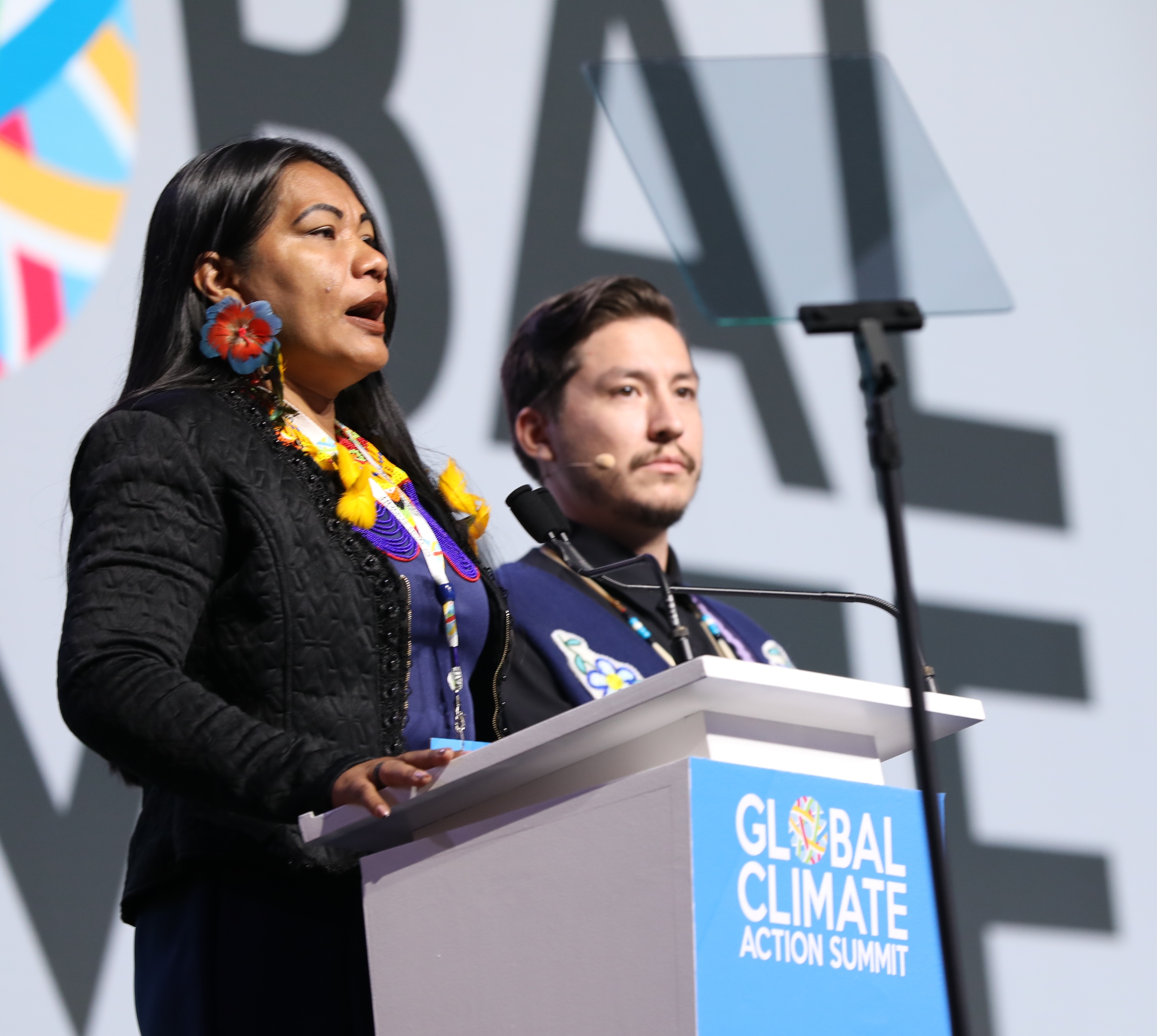
Indigenous and tribal leaders Francisca Oliveira de Lima Costa (left) and Dana Tizya-Tramm (right) speak during the Global Climate Action Summit.
Outside the Summit - and occasionally from inside - climate justice activists led by
indigenous people and women demanded that fossil fuels be left in the ground and that no new fossil fuel infrastructure be developed. They questioned how a global economic system that prioritizes profit and commodifies nature could be consistent with the level of changed needed to limit warming to 1.5°C while achieving social, racial, and economic justice for all.
Hundreds of affiliate events related to the Summit took place during the week, regarding topics from art, science, and education, to food waste, investments, and transportation technologies.
One of the affiliate events was a
Global Climate and Health Forum, intended to “mobilize health action for climate and climate action for health”. Dr. Karen Smith, Director of the California Department of Public Health and State Public Health Officer, welcomed the attendees, saying, “Under Governor Brown’s leadership we in California are leading the way, showing what states can do to reduce greenhouse emissions, and to prepare for and respond to the impacts of climate change…we are also leading the way in tying our climate action work to equity and increasing health equity and social justice. They are part and parcel of the same thing.” She noted that California has experienced directly the catastrophic impacts of climate change, and that these impacts are disproportionately affecting our most vulnerable communities. She finished by exhorting clinicians, public health and environmental health professionals to mobilize around climate action that protects health and creates resilient communities.
Wael Hmaidan, Executive Director of Climate Action Network International, asserted that financial resources are not lacking to drive a rapid transition to a healthier and climate-safe world; but rather than what is lacking is the political will to do so. He echoed a common theme when he called for policies that “Stop subsidizing fossil fuels. Put that to renewables, and problem solved.” He encouraged participants to mobilize with faith and medical communities to focus on actions that can improve health and the climate, saying, “Imagine faith leaders talking every couple of months from the pulpit about climate change.”
 Dr. Maria Neira, World Health Organization, speaking at the Global Climate and Health Forum.
At the Global Climate and Heath Forum, dozens of leading health organizations representing more than five million doctors, nurses, and public health professionals, and 17,000 hospitals in more than 120 countries announced commitments and unveiled a
Call to Action on Climate and Health aimed at accelerating stronger advocacy and action in addressing climate change — “the greatest health threat of the 21st century”. Among the commitments were more than 176 health care institutions representing 17,000 hospitals and health centers in 26 countries that will reduce their carbon emissions by more than 16 million metric tons a year— the equivalent of shutting down four coal fired power plants.