Love is Thicker Than Smoke
By Linda Helland, MPH, CPH
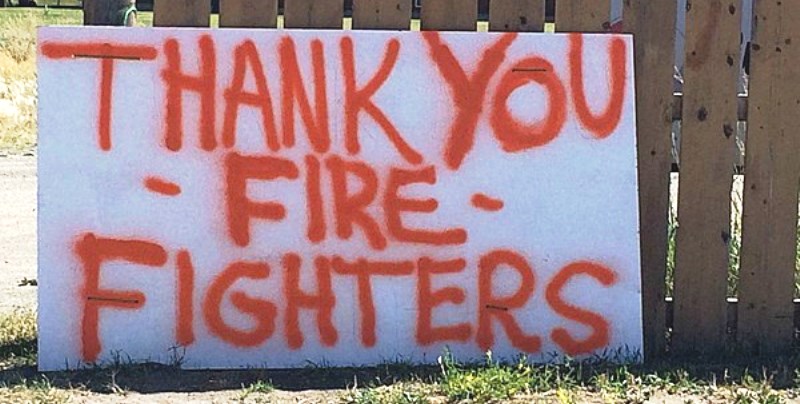
I am profoundly grateful to CAL FIRE and all the other firefighters and first responders, including the inmates who risk their lives to save our neighbors and property. Their heroism saved my partner’s and my house on Pine Mountain in Mendocino County on October 11th and 12th. I am thankful our tax dollars pay for those public services.
Tragically, at least 42 people, 27 of them elderly and some with disabilities, perished in the fires in Napa, Sonoma, and Mendocino, and at least 8,700 homes burned in this deadliest wildfire disaster in California's history. People lost their loved ones, animals, homes (some without insurance), livelihoods, vehicles, life savings, family photos and heirlooms, kids' first grade artwork, and the sense of being safe in their own home. I know I'll never turn off my cell phone again.
I fear that there will ultimately be more illness and deaths from breathing the smoke that millions of people have been exposed to, than even from the fire. Local hospitals reported increases in patient volume due to respiratory and cardiovascular ailments, but we won't know the actual numbers for months. The mostly Latino farmworkers whose workplaces didn't burn went back to work harvesting grapes, despite the choking air quality. And then there will be the mental health impacts, which may dwarf even the harm from smoke. These effects often accrue first and worst to communities facing inequities due to racism, poverty, immigration status, disability, language, lack of mobility, and other forms of systemic deprivation of resources.
This cataclysm, death, and illness is exactly what our Climate Change and Health Equity Program's work and tools exist to prevent and prepare for, so I feel some sense of personal failure at this devastation, as well as the ongoing trauma in Puerto Rico that has received much fewer resources to cope and recover than have been brought to quell the Northern California inferno.
CAL FIRE is the best in the business, and our local and state agencies valiantly stretched the resources they have, and didn't sleep for days in their dedication to service once the fire broke out. And still -- we were not ready for this, in the richest state of the richest country the world has ever known.
Cell phone service went out. Land lines went down. Electricity went out. Old fashioned two-way radios including amateur or "ham" radios were the most effective means of communication. Many people I've heard from that fled for their lives from the advancing flames in Redwood Valley did not get the reverse 911 call that the Sherriff's office sends to local residents' telephones to warn of emergencies (if they have the numbers). Instead, they were awoken by the sound of propane tanks exploding, neighbors calling or honking car horns as they fled. It took about two days for Spanish translation of notices and meetings to get up and running, and for the guarantees to undocumented people not to fear deportation when evacuating. Homeless people received no notice. Entire neighborhoods burned without a first responder there, it happened so fast, and there were not enough of them. For the first 24 hours there were only just over 400 firefighters in Mendocino County.
When I returned to the office after evacuating the fire zone, I pulled up the Climate Change and Health Profile Report our program completed for Mendocino County, and felt a chill up my spine.
| Wildfire Hazard Severity Zones, 2007, Mendocino County | Actual Fire Areas, October 9, 2017 |
 | 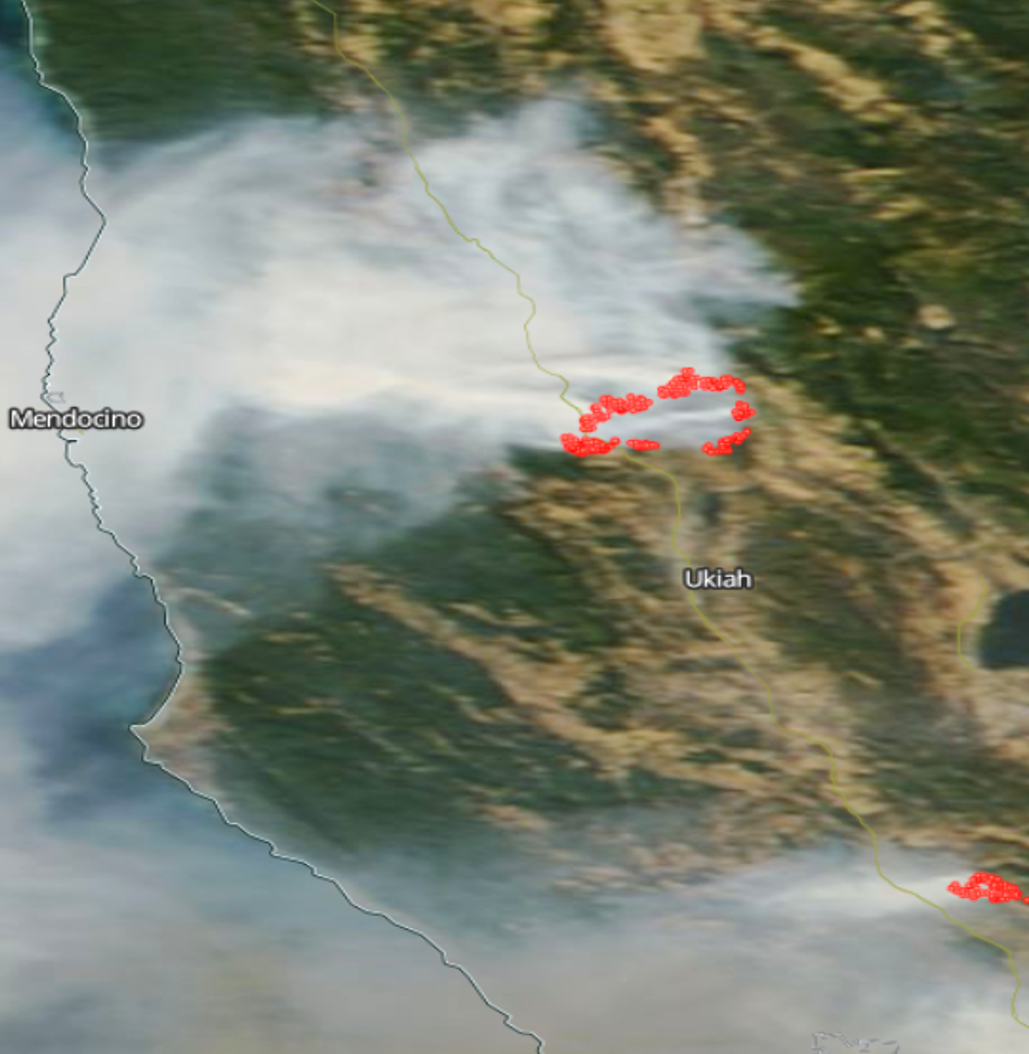 |
California Department of Forestry and Fire Protection (CAL FIRE). Fire and Resource Assessment Program; http://frap.cdf.ca.gov/. | Map by Nasa Worldview, 2017. |
While by no means an exact match, the map on the left from 2007 shows current very high wildfire severity zones in red, and on the right is a map of the actual fires on October 9th from Nasa Worldview. We should not have been surprised. In 2010, approximately 44% of the county's population lived in fire hazard zones of moderate to very high severity. Our report also foretold which people may be at higher risk of health impacts from such extreme events. In 2012, nearly 46% of adults in Mendocino County reported one or more chronic health conditions including heart disease, diabetes, asthma, severe mental stress or high blood pressure, which put them at higher risk of harm from climate change exposures such as fire or smoke. Fifteen percent of adults were older than 65. You can find this information for each California county here.
This map from the Mendocino County Climate Change and Health Profile Report shows the increase in area projected to burn in 2085 compared to 2010.

Source:
Public Interest Energy Research (PIER) Program. Cal-Adapt: Exploring
California's Climate Change Research. Sacramento: California Energy Commission;
2011. http://cal-adapt.org/
A Substantial increase in fire risk is expected throughout the region. By 2020 about 30% more area is expected to have a very high wildfire risk, and by 2080 there may be up to a 3.5 times greater area with very high risk, under a high or business as usual greenhouse gas emissions scenario. We have these data, so fires should no longer come as a surprise to us.
Two words that have been conspicuously absent from the media coverage of both the fires and the hurricanes, have been "climate change". Climate change has lengthened the fire season, contributed to high heat and drought, which prepared the tinderbox for the fires.
A recent study by Abatzoglou and Williams showed temperature increases caused by rising levels of greenhouse gas pollution have had a drying effect on Western forests that caused about 10.4 million acres to char in large fires from 1984 to 2015. That means human-caused climate change accounted for about 44 percent of the forest area that burned. One of the authors stated, "The exact percentage of human contribution remains uncertain, but the overall relationship — an increase in fuel aridity, fire days, and fire extent — is clear and significant."

Photo: Anne Saunders, 2017.
The phrase "the love in the air is thicker than the smoke" has become common in wine country since the day after the blazes broke out. I could tell you dozens of touching stories of people's kindness and generosity to each other, like the retired firefighter who planned to stay and fight the fire to save his house, but then found three elderly people walking on the road in their bathrobes between walls of flame, and ferried them to safety, abandoning his home to the conflagration. Social capital, knowing and trusting our neighbors, is a force for resilience and saved lives. And yet it's not enough. We need a robust firefighting force throughout the ever-lengthening fire season, with the same personnel thinning the underbrush and reducing the fuel load in the forests throughout the winters. We need planning, we need a well-resourced government, we need a massive dedication of resources on the scale of the World War II effort, but this time towards reducing and preparing for climate change and its impacts, to prevent this kind of tragedy from happening again.
Linda Helland is the Team Lead for the Climate Change and Health Equity Program of the Office of Health Equity.