 | Essentials for Childhood Initiative One-Pager (PDF): This document is intended for current and prospective Positive and Adverse Childhood Experiences (PACEs) partners and was designed to describe the Essentials for Childhood (EfC) Initiative, the mission, vision, primary focus areas, and how the Essentials for Childhood (EfC) Steering Committee supports and guides the Initiative.
|

| The Evidence-Based Youth Mentorship Programs Brief is intended to educate local health departments and child-serving systems about evidence-based youth mentorship programs that can foster adult and youth engagement, support violence prevention efforts, and promote Positive Childhood Experiences (PCEs) as a counter to Adverse Childhood Experiences (ACEs).
|

| The Impact of Positive Childhood Experiences (PCEs) on Behavioral Health Outcomes is a resource developed to support and educate violence prevention partners and those who work within child-serving systems about community-led efforts to adopt and implement evidence-based strategies that can prevent Adverse Childhood Experiences (ACEs), promote PCEs, and improve the lives of California's children, families, and communities.
|

| Utilizing Data to Improve Child Wellbeing Through Community
Action: The purpose of this document is to identify best practices
in utilizing data to monitor and evaluate child adversity, health, development,
and wellbeing in order to build community support and create policy, systems,
and environmental change. This resource was created in partnership by All Children Thrive -
California and the California Department of Public Health,
Injury and Prevention Branch (CDPH/IVPB) and the California Department of
Social Service, Office of Child Abuse Prevention’s (CDSS/OCAP)’s, EfC
Initiative.
|

| The Adverse and
Positive Childhood Experiences Data Report: Behavioral Risk Factor Surveillance
System (BRFSS), 2015-2021: An Overview of Adverse and Positive Childhood
Experiences (PDF): The
purpose of this resource is to report the prevalence of ACEs in California;
describe ACEs-related geographic and demographic disparities; and to offer
details on the impact of ACEs on mental health, behavior, and chronic disease.
|

| Strategies for Trauma-Informed School Communities: Practices to
Improve Resiliency in School-Aged Children and Address Adverse Childhood
Experiences: This resource is intended to assist state and local
public health programs, child-serving systems, non-profits, and philanthropic
organizations in their efforts to educate about the need for trauma-informed
school policies and practices that improve resiliency in school-age children
and youth.
|
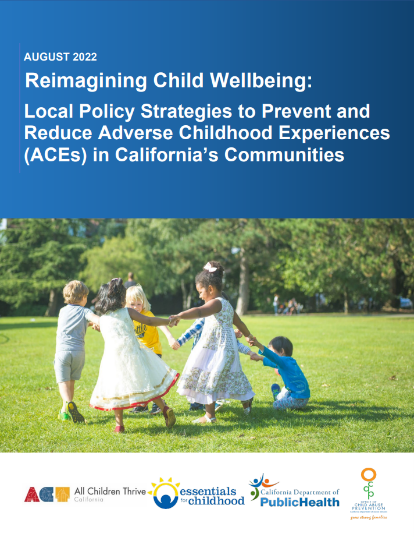 | Reimagining Child Wellbeing: Local Policy Strategies to Prevent and Reduce Adverse Childhood Experiences (ACEs) in California's Communities.
|

| The PACEs in California
Data Report: California Health Interview Survey (CHIS), 2021 resource was developed to provide an overview
of the 2021 PACEs data from the CHIS. It is intended to be used by PACEs
stakeholders, including community coalitions and community-based organizations,
decision-makers, and state and local government representatives, to educate
about the prevalence of PACEs in California and guide efforts to reduce ACEs
and promote PCEs.
|
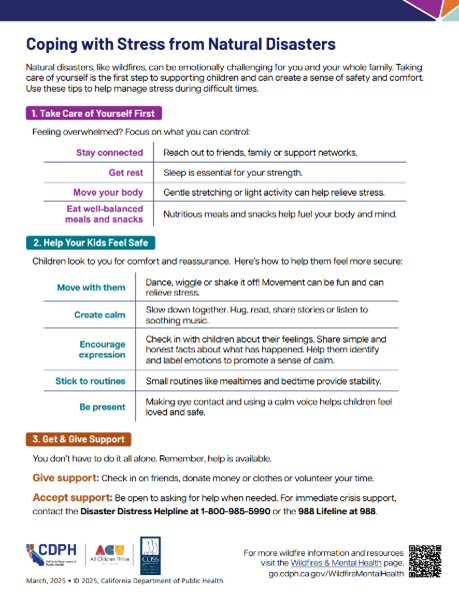
| Coping with Stress
from Natural Disasters is a resource that
presents actionable steps that parents and caregivers can take to care for
themselves, their children, and their community, as well as a list of resources
to help them get connected to services and disaster relief/assistance programs.
This resource is available on the CDPH Wildfires &
Mental Health webpage in eight
different languages, including English, Spanish, Armenian, Traditional Chinese, Simplified Chinese, Korean, Tagalog, Vietnamese.
|
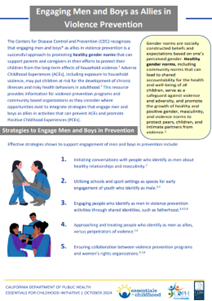
| Engaging Men and Boys as Allies in Violence Prevention[PC1] : This is a resource that presents strategies that have been shown to support the engagement of men and boys as allies in violence prevention and limitations to consider when utilizing this approach.
|
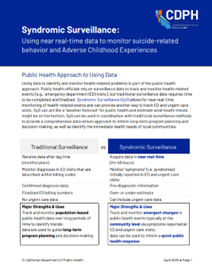
| Syndromic
Surveillance Brief: Using
near real-time data to monitor suicide-related behavior and Adverse Childhood
Experiences provides an overview
of Syndromic Surveillance (SyS) and how it is different than traditional
surveillance. Additionally, this resource describes how SyS can be used to
monitor suicide-related behaviors, ACEs, and the relationship between the two.
|
| The California Child
Death Review Team (CDRT) Toolkit
was developed by the California
Critical Incidents Review Panel (CA CRP) to assist county agencies working to sustain,
create or revive CDRTs in their jurisdictions in California. The toolkit will
help counties assess their existing CRDTs and develop policies and procedures
to sustain or improve their process. In those counties where there is no
existing CDRT, this toolkit will help support and educate local policymakers to
better understand the role of CDRTs and will facilitate efforts to create an
effective CDRT.
|
| Connecting Families
to Tax Credits to Improve Child Wellbeing in California: A brief for California Local Health
Departments and Children and Family Service Providers is intended to assist
LHDs and children and family service providers in their efforts to educate
about how the collection of the California Earned Income Tax Credit (CalEITC),
California Young Child Tax Credit (YCTC), federal EITC, federal Child Tax
Credit, and other associated tax credits can improve the wellbeing of
Californians.
|
| The
Four Building Blocks of HOPE Handout describes the four key types of PCEs that all children
need to thrive and strategies to promote and elevate supportive relationships;
environments; civic engagement; and social and emotional growth.
|
 | A Trauma-Informed Approach to Active Transportation: Recognizing the Relationship between Adversity, Resiliency, and Active Transportation Brief: A resource developed to support the efforts of active transportation safety partners and stakeholders as they work to educate decisionmakers about where opportunities exist to adopt and implement trauma-informed practices and approaches.
|
| California Child Wellbeing Coalition e-Guide (PDF):
This digital resource intended to support state and local public health
programs, child-serving systems, non-profits, and philanthropic organizations
that are interested in collaborating with organized groups at the local-level
who are working to achieve child wellbeing through policy, systems, and
environmental (PSE) change. The e-Guide is intended to be a living document and
does provide an exhaustive list of all coalitions in California; if you have
any questions, concerns, or suggested updates, please contact the EfC
Initiative Project Team at: ivpb@cdph.ca.gov.
|
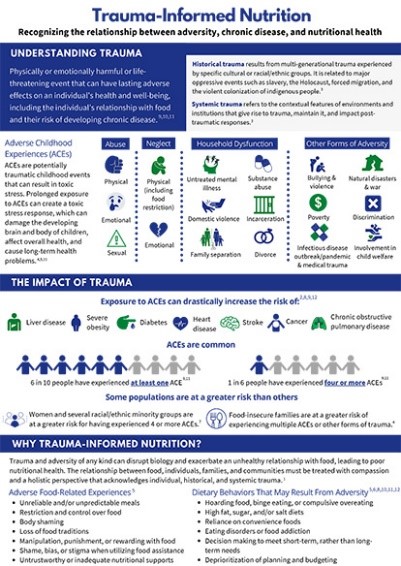
| Trauma-Informed Nutrition: Recognizing the Relationship between
Adversity, Chronic Disease, and Nutritional Health: This factsheet
is intended for Registered Dietitians (RDs) and was designed to support and
describe the connection between Adverse Childhood Experiences (ACEs), the
impacts of trauma and its relationship to chronic disease, and trauma-informed
nutrition practices. This factsheet was developed through a collaborative
partnership with CDPH's Nutrition Education Obesity Prevention Branch (NEOPB).
|
 | The Centers for Disease
Control and Prevention Division of Violence Prevention released the Adverse Childhood
Experiences (ACEs) Resource for Action: (previously known as a technical package) This
is a select group of strategies based on the best available evidence to prevent
or reduce public health problems like violence. They can help improve the
health and well-being of communities.
|
 | The Centers for Disease Control and Prevention Division of Violence Prevention released the Child Abuse and Neglect Prevention Resource for Action: (previously known as a technical package) This is a select group of strategies based on the best available evidence to prevent or reduce public health problems like violence. They can help improve the health and well-being of communities.
|

| Violence, including child abuse & neglect, intimate partner violence, sexual violence, suicide, and youth violence can be stopped before it starts. Learn how with VetoViolence, CDC's online violence prevention resource.
|
| Connecting the Dots: A violence prevention website created by the CDC offers resources about using shared risk and protective factors to prevent multiple forms of violence and a number of other tools to support those working to prevent violence in thinking strategically about coordinating responses.
|